

About WESS
 Water Efficient Sanitation Solutions (WESS) are a suite of non-sewered, off-grid or on-site technologies that increase the efficiency and reduce the need for potable water to convey, store or treat human waste. These systems operate at or near the point of waste generation and provide the same level of public health protection and environmental safety as conventional sewered services, without the need for costly underground infrastructure. Especially relevant in contexts marked by water scarcity, ageing infrastructure, and expanding peri-urban settlements, WESS offer a practical alternative for areas where extending traditional sewer systems is not feasible or affordable. Each flush in conventional toilets can consume six to nine litres of water, where in contrast, WESS offer lower flush options and resource-recovery potential. The features of WESS make them particularly interesting for implementation in contexts such as informal settlements, schools, social housing and private developments.
Programme
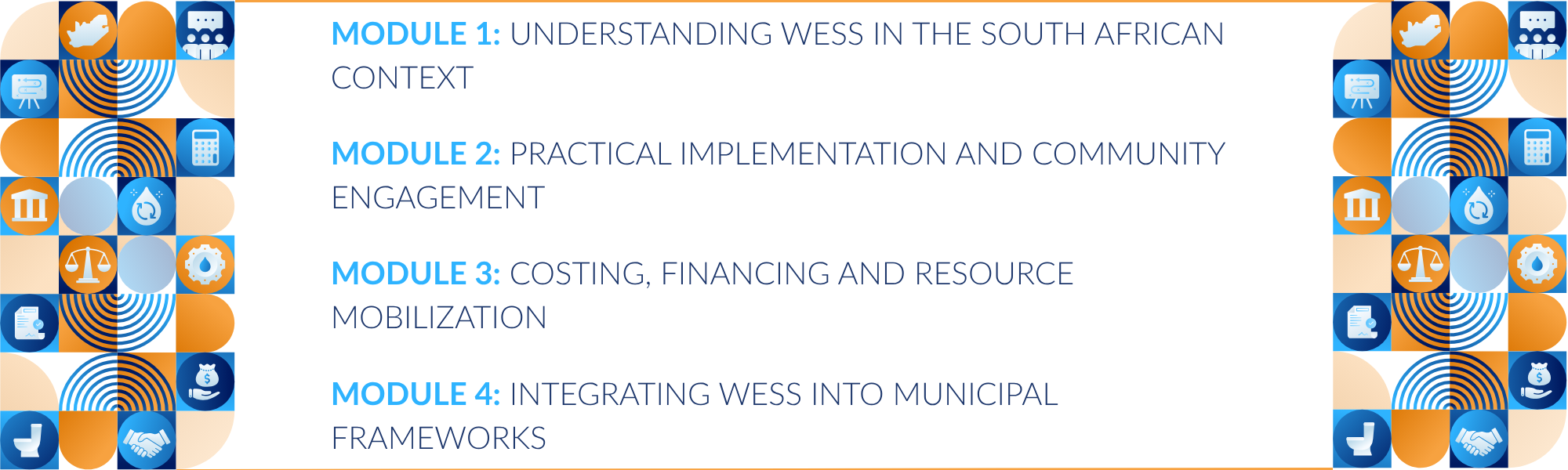
Each training will be structured in 4 modules
Module 1
This module offers an essential overview of Water-Efficient Sanitation Systems (WESS) in South Africa, empowering participants to evaluate and implement suitable technologies. Key objectives include analysing the regulatory landscape and policy frameworks driving WESS adoption. Participants will also examine current trends, including water scarcity and climate change, influencing the shift from traditional sanitation systems. Additionally, the module defines WESS, focusing on their advantages, contextual suitability, and resource needs, ensuring a practical understanding for effective application in diverse South African environments.
| Learning objectives |
|
Contents
- Introduction to (safely managed) sanitation in South Africa, including current situation
- How the regulatory landscape is directing to innovative solutions
- Challenges related to conventional solutions, exacerbated by current trends (water scarcity, climate change, growth of informal settlements, etc.)
- Introduction to WESS
- Features, advantages and suitability of WESS
- Examples based on the local case studies
Module 2
This module provides detailed insights into practical implementation processes, operational and maintenance needs, and community engagement strategies critical to the success of water-efficient sanitation systems (WESS). Participants will learn to integrate technical specifications, institutional arrangements, and social factors, ensuring comprehensive understanding and effective project implementation in the South African context.
Contents
- Water input requirements and implications for different WESS systems
- Wastewater treatment processes involved in WESS
- WESS technical specifications overview
- Operation and maintenance requirements of WESS
- Institutional models for WESS for O&M, emphasizing technology transfer
- Community engagement recommendations
| Learning objectives |
|

Module 3
This module equips participants with the essential skills to develop financially sound and sustainable WESS project plans, emphasizing a shift from cost minimization to long-term value maximization and exploring key funding avenues. The module focuses on building a compelling business case that prioritizes the project’s cost-effectiveness and secures funding for sustainable WESS implementation. Participants will learn to conduct preliminary cost-benefit analyses and develop effective funding strategies.
| Learning objectives |
|
Contents
- Costs involved in WESS
- Life-cycle cost estimation and comparison with other conventional solutions
- Key concepts related to cost-benefit analysis
- Key funding sources in South Africa
Module 4
This module tackles the current challenges faced by municipalities while trying to integrate WESS into existing frameworks, such as Integrated Development Plans (IDPs), absence of relevant policies and bylaws supporting the adoption of WESS and obstacles related to procurement process. Therefore, it focusses on integrating WESS projects within existing municipal frameworks, equipping participants with the skills to promote procurement of WESS and develop a preliminary procurement strategy for WESS in viable target areas.
Contents
- Mechanisms of procurement
- Barriers and enablers for WESS adoption
- Challenges and 3As evaluation
- Action planning
| Learning objectives |
|
Agenda

This series of trainings is a collaborative effort of the:
 |
 |
 |
 |
 |
This training was prepared for the Gates Foundation. The findings and conclusions contained within are those of the authors and do not necessarily reflect policies of the Gates Foundation.